
Cloud services have transformed how legal work gets done, and law firms have moved more of the matter lifecycle into the cloud than ever before. As firms modernize, many are also formalizing their business continuity requirements – building in independent, firm-controlled recovery paths for matter documents – the contracts, court filings, research, and client correspondence that they need to keep working.
HYCU and iManage have collaborated on a new solution, R-Serve, that gives firms exactly that: an independent, self-service way to reach their documents. In this Q&A, Ashish Rao, Senior Product Marketing Manager at HYCU, and Nadine Weiskopf, Principal Product Marketing Manager at iManage, explain how R-Serve protects firms with an additional layer of resilience by providing iManage end users secondary access to the documents they own.
Why is continuous access becoming a priority for legal organizations?
Nadine Weiskopf, iManage: Nearly every critical business process now runs in the cloud. For legal organizations, that includes the documents and information people need to serve clients, collaborate across teams, and meet deadlines that cannot move.
Cloud platforms deliver tremendous benefits: cost efficiency, high availability, and scale. iManage Cloud is engineered for that resilience with a proven 99.9% availability, and global firms rely on it every day. As firms continue to modernize their technology environments, though, business continuity, data sovereignty, and information governance have become board-level concerns in their own right. Clients are placing greater scrutiny on how firms protect and can independently access sensitive information, and internal audit and compliance functions increasingly expect firms to demonstrate a documented continuity plan — not simply point to the resilience of any one platform. That's a conversation we're having with more firms every quarter.
What would happen inside a firm if document access were interrupted?
Ashish Rao, HYCU: The impact would be immediate, and it would start before anyone knows what is wrong. Users begin reporting that they cannot access documents. IT has to work out whether the problem is local, firmwide, or upstream. Confirming the nature of an outage would take time on its own.
Meanwhile the work would not pause. Someone is preparing a same-day filing, supporting a transaction that is mid-close, or working an active trial. Every minute without access affects productivity, billable work, and client service. This is exactly the scenario that firms want a clear, documented plan for – one that gives them confidence they’ve addressed it, rather than hoping it never comes up.
What is the business impact of that?
Ashish Rao, HYCU: It adds up faster than most people expect. Based on an independent HYCU analysis of industry billing rates and downtime scenarios across professional services firms, a 200-attorney firm billing at an average rate of $1,145 per hour could face approximately $458,000 in lost billable opportunity if its data becomes inaccessible for even two hours.
That figure does not account for missed deadlines, delayed client work, contractual consequences, or reputational damage. For document-intensive, deadline-driven organizations, the window between the start of an interruption and the resumption of productive work is where most of the business impact lands. This is why many firms want to take business continuity planning into their own hands.
If a firm already takes independent backups of its iManage data, why does it need R-Serve?
Ashish Rao, HYCU: Backups are important and they exist to recover information that has been deleted, corrupted, encrypted, or otherwise lost. If the primary path to that data was unavailable, though, every knowledge worker at the firm would be looking to retrieve their documents at once.
IT teams can pull priority documents out of backup for individual users, but that approach simply does not scale across hundreds or thousands of knowledge workers. Administrators become a bottleneck, preparing exports and working through requests one at a time while the clock runs.
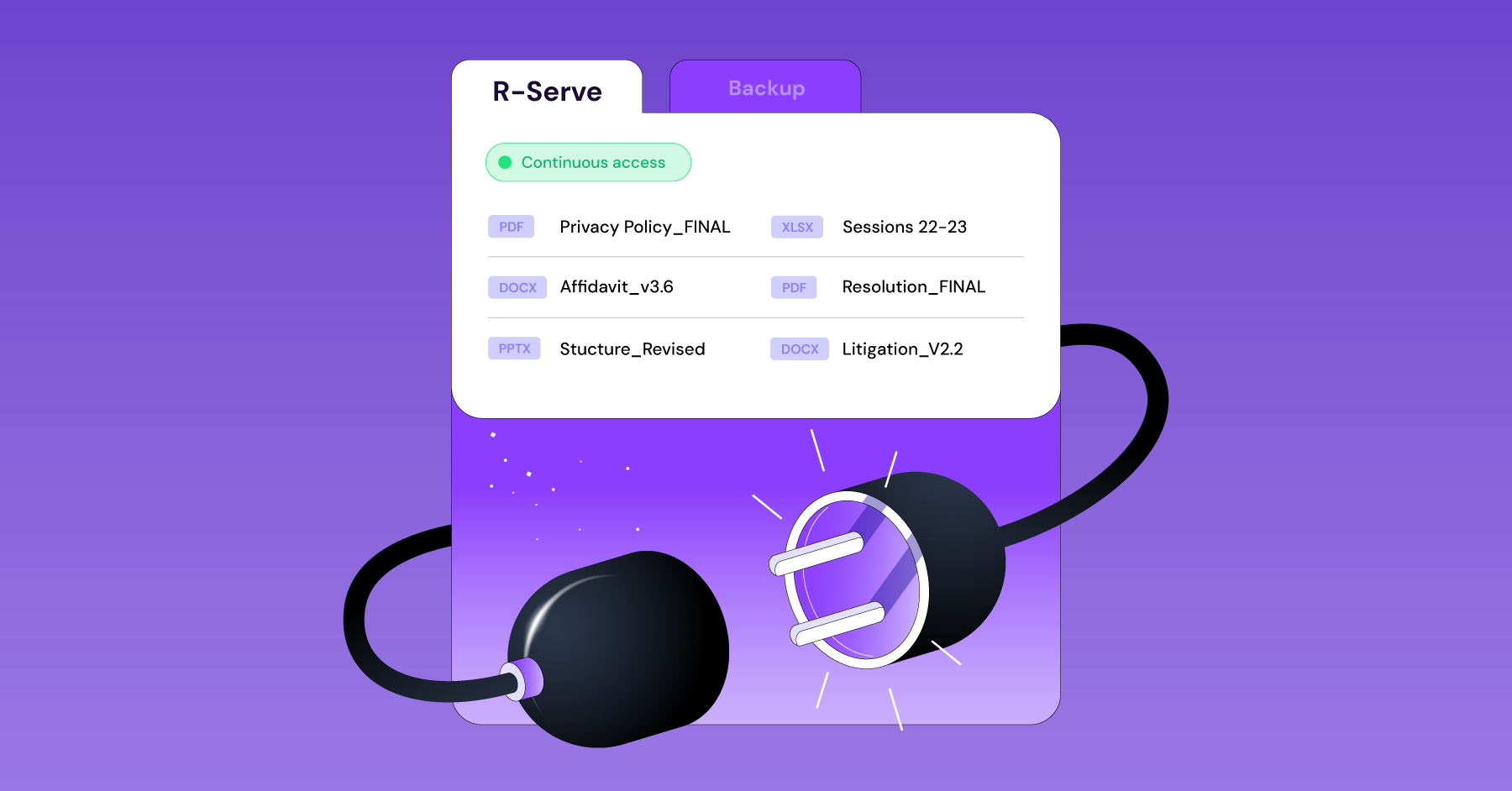
R-Serve builds on the backup rather than duplicating it. It gives authorized users a way to reach the documents they need directly, without IT having to fulfil every request by hand.
What exactly is R-Serve?
Ashish Rao, HYCU: R-Serve is HYCU's new continuous access layer for organizations using iManage Cloud. It builds on the capabilities of the HYCU R-Cloud platform, which continuously captures application changes and maintains independent recovery points for protected SaaS data.
R-Serve extends that foundation beyond traditional recovery. It gives authorized users an independent, self-service way to reach their protected matter documents. The idea behind it is simple: continuous access should be something firms plan for and control, not something they hope for.
How does R-Serve work?
Ashish Rao, HYCU: R-Serve runs as a web service entirely within the customer's own cloud infrastructure, and it stays available at all times once configured.
Users sign in to R-Serve through the organization's existing single sign-on or identity solution, such as Microsoft Entra ID. There are no new credentials to manage and no separate account to provision.
From there, users can search, filter, and download the documents they need. R-Serve is not an editing environment, so access is read-only. Anyone who needs to work on a document downloads it and works offline on their own device. Changes can be reconciled by uploading their updated documents back to iManage Cloud. R-Serve does not write anything back, by design.
How does R-Serve handle iManage security and access controls?
Nadine Weiskopf, iManage: This was one of the first things we looked at closely. Protecting matter content means protecting the controls around it, not just the content itself.
R-Serve does not create a permission model of its own. Access is scoped to the documents each user owns and operates in iManage. Only administrators retain full library visibility for oversight, along with bulk download of data and advanced filtering, and every sign-in and download is logged.
How is continuous access different from backup and recovery?
Ashish Rao, HYCU: Backup and recovery restores information after it's been lost, corrupted, or compromised. Continuous access is different. It gives people a way to reach their documents on an ongoing basis, independent of the production environment, without going through IT for every request.
Both matter, but they solve different problems. Recovery protects against data loss. Continuous access protects productivity — it lets authorized users keep working on the firm’s own terms.
R-Serve brings the two together. It builds continuous, self-service access on top of the same independent, protected data that HYCU R-Cloud already maintains through backup.
Why does this matter specifically for legal organizations?
Nadine Weiskopf, iManage: Legal work runs on timely, secure access to information. People have to serve clients, respond to courts and counterparties, and meet deadlines that cannot move just because they cannot reach their cloud data.
R-Serve gives organizations an additional layer of resilience and greater data sovereignty, with their protected copy held in storage they control, in the jurisdiction they decide. For firms building out their business continuity plans, that is a meaningful addition.
Is R-Serve a replacement for iManage or its resilience capabilities?
Nadine Weiskopf, iManage: No. R-Serve is an additional business continuity layer designed to complement the resilience that organizations already get with iManage Cloud.
It is not a document management system, and it is not somewhere work happens. It is read-only by design. Once service is restored, users go back to iManage and bring any work they completed locally with them. iManage remains the system of record.
Is R-Serve available now?
Ashish Rao, HYCU: Yes. R-Serve is available today for organizations protecting their iManage data with HYCU R-Cloud, at no additional cost.
iManage is the first workload R-Serve supports. HYCU plans to extend the same continuous access approach to additional workloads in future releases.
How can firms enable R-Serve or see it in action?
Ashish Rao, HYCU: Existing HYCU R-Cloud customers protecting iManage data can contact their HYCU representative to enable R-Serve.


Get the newest insights and updates
By submitting, I agree to the HYCU Subscription Agreement , Terms of Usage , and Privacy Policy .